
Data Critique — Overview
Our dataset, Across the Timeline, was created in 2018 following Notre Dame’s 2nd NCAA championship led by Arike Ogunbowale. According to the site’s founder, Maitreyi Anantharaman, the goal of the site was to “create a space dedicated to the history of women’s basketball.” [1] Across the Timeline seeks to expand the data available about the WNBA and delve into the stories of the players, coaches, and games. Through this process, we can better connect the league today to its storied past.
Citations
[1] Anantharaman, Maitreyi. “Across the Timeline – Stats, Facts, and Memories from the Storied History of Women’s Basketball.” Across the Timeline. Accessed August 3, 2024. https://www.acrossthetimeline.com/.

Image: Mark Schindler, WNBA
Data Critique — Questions
To better understand our dataset, we asked specific questions about what it showed and what it didn’t.
Our dataset ‘Across the Timeline’ contains data about the WNBA since its inception in 1997. This data includes player transactions, draft picks, game attendance, top players, awards, and many more datasets detailing the history of the league. [1] This data is categorized by year, going back as far as 1997. [1]
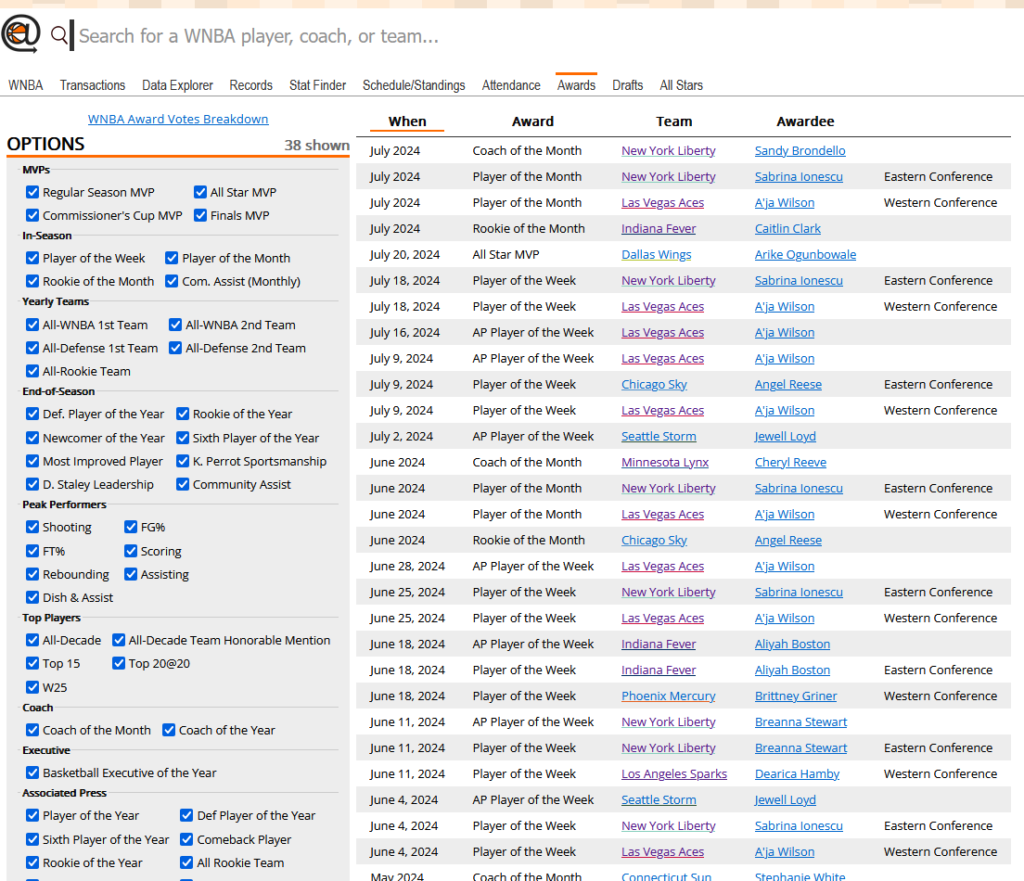
Image: Across the Timeline Awards Data, Maitreyi Anantharaman
While our dataset included a large amount of information regarding the WNBA and its history, we noticed it lacked information on viewership, which is important to understand how most fans are interacting with the game. This distinction is crucial, as attendance measures only those physically present, whereas viewership captures a broader audience. Additionally, the dataset did not include player information such as background and ethnicity, which would have been helpful to understand differences in player characteristics over time.
The lack of viewership data was an issue as attendance at games is only a fraction of the amount of people that watch games. Most viewers prefer to watch games on television instead of commuting and spending money at arenas. In a 2022 Nielsen report, 80% of sports fans, 76% of NFL fans and 89% of soccer fans were reported to have regularly or sometimes watched sports on any streaming or online channel that year. [2] In a similar manner, without access to salary data, we were unable to gauge whether or not growth in the league equated to more fair compensation to the players. This data is crucial as it allows us to relate the league’s growth to broader global issues, such as women’s equality in the workforce.
Another important form of information that the dataset lacks is a comparison to other leagues such as the NBA. Without this data, people who view the timeline lack context on the numbers they are viewing. For example, they may think the attendance numbers for WNBA games are extremely high until they are able to compare them to the NBA.
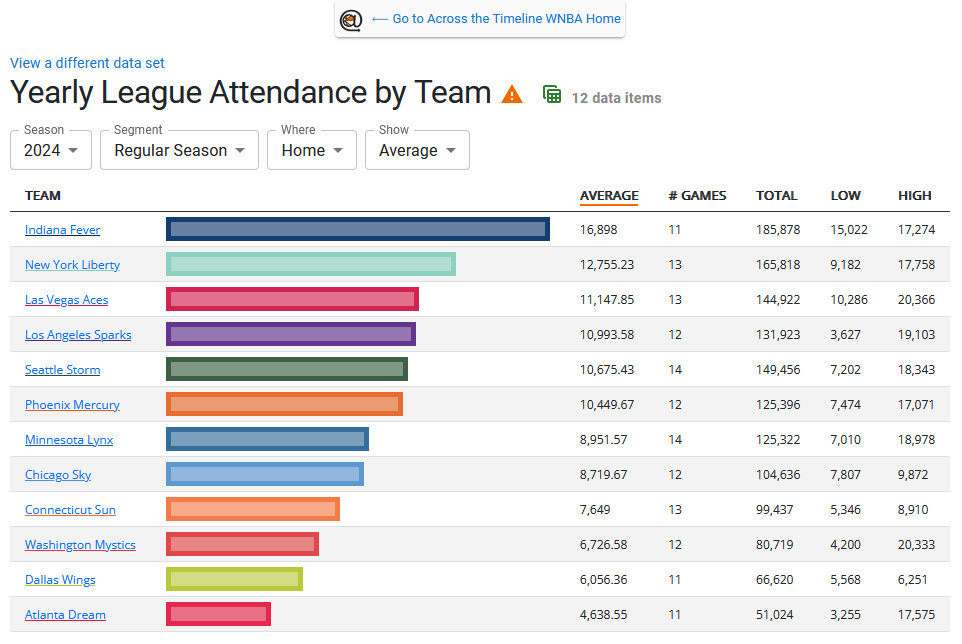
Image: Across the Timeline Attendance Data, Maitreyi Anantharaman
Despite the data that Across the Timeline lacked, attendance data was valuable for our project. Attendance numbers was a crucial part of our project as it allowed us to track the physical growth of the WNBA. We used attendance data, along with secondary and primary sources, to address topics about: 1. Disparities between the WNBA and NBA, 2. How cultural and political climates influence the league’s popularity and values, and 3. How attitudes within the league are affected by its growth. Overall, Across the Timeline enabled us to answer our research questions and helped us to create visualizations.
Citations
[1] Anantharaman, Maitreyi. “Across the Timeline – Stats, Facts, and Memories from the Storied History of Women’s Basketball.” Across the Timeline. Accessed August 3, 2024. https://www.acrossthetimeline.com/.
[2] Nielsen. “Live Sports Are Headed to Streaming Services, and Audiences Are Ready.” Nielsen, October 10, 2022. https://www.nielsen.com/insights/2022/live-sports-are-headed-to-streaming-services-and-audiences-are-ready/.
Data Critique — Ontology
What data is considered valuable?
The site was created in 2018 by Maitreyi Anantharaman with the goal of providing “a space dedicated to the history of women’s basketball.” [1] Across the Timeline helps fans and supporters understand the history of the league and how it has progressed through the years. Data on attendance, trades, schedules, and awards are specifically chosen to chronicle the history of the WNBA, which is the goal of the site. Across the Timeline contains data often associated with professional sports leagues, with the exception of finances and viewership numbers. In an academic journal written by Donald Staffo, he posits that women’s sports are more purpose-driven due to the disparity in finances and attention compared to their male counterparts. [2] With this in mind, one can argue that data like awards and trades are more relevant in maintaining a purpose-driven narrative of a woman’s professional sports league like the WNBA.
Citations
[1] Anantharaman, Maitreyi. “Across the Timeline – Stats, Facts, and Memories from the Storied History of Women’s Basketball.” Across the Timeline. Accessed August 3, 2024. https://www.acrossthetimeline.com/.
[2] Staffo, Donald F. “THE HISTORY OF WOMEN’S PROFESSIONAL BASKETBALL IN THE UNITED STATES WITH AN EMPHASIS ON THE OLD WBL AND THE NEW ABL AND WNBA.” Physical Educator 55, no. 4 (Winter, 1998): 187. https://www.proquest.com/scholarly-journals/history-womens-professional-basketball-united/docview/1437911016/se-2.